
Upcrest Digital designs & delivers Salesforce solutions for municipalities, cities, and agencies across Canada and the US.
Government organizations today face mounting pressure to deliver faster, more transparent services while managing constrained budgets and aging systems. Our Salesforce Public Sector Solutions help municipalities and local government modernize how they operate — improving service efficiency, resident experience, and cross-department accountability without disrupting day-to-day operations.
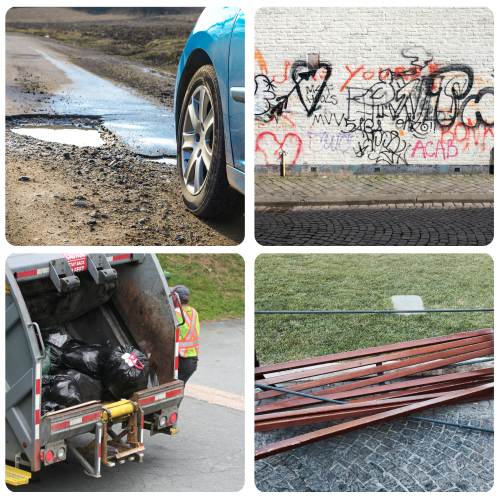
311 and service request modernization, resident portals, permitting, bylaw enforcement, case management, and field service coordination.
Program intake and delivery, case management, compliance tracking, inter-ministry collaboration, and executive reporting.
Cross-municipal service coordination, shared service platforms, regional planning support, and resident engagement solutions.
Salesforce solutions for non-profits, education, utilities, and public-private partnerships operating in regulated environments.
Our Salesforce 311 service request management solution centralizes all resident submissions into a single platform, enabling automated routing, SLA tracking, and real-time status updates for municipalities.
Built for municipalities and local governments, the 311 modernization solution improves response times, increases transparency, and provides leadership with actionable insights to continuously improve service delivery without increasing staff workload.
Learn moreOur municipal permitting, licensing, and inspections software digitizes application intake, approvals, inspections, and fee management through configurable workflows built for municipal regulatory teams.
From online applications to field inspections and fee settlement, the online permitting system gives municipalities end-to-end visibility and control over their regulatory services — reducing processing times and protecting revenue.
Learn moreOur municipal case management software provides a centralized platform for managing council inquiries, resident escalations, and cross-department service cases — with shared context, audit trails, and executive dashboards.
Standardized workflows ensure accountability, reduce handoff delays between departments, and give leadership the visibility they need for governance reporting and evidence-based decision-making for municipal and local government.
Learn moreOur municipal emergency response management software solution enables municipalities to rapidly scale service intake, prioritize safety-critical requests, and coordinate cross-department responses during floods, storms, and infrastructure disruptions.
Real-time coordination, automated resident communications, and executive dashboards give leadership the situational awareness needed to make informed decisions during high-pressure events.
Learn moreWe deliver secure, resident-centric solutions tailored to the needs of public sector and regulated organizations.
From 311 and service requests to permitting, case management, and emergency response, we cover the full spectrum of digital services.
We build solutions alongside your team — department leads, IT staff, and frontline workers are all part of our process.
Every implementation is scoped around defined outcomes — reduced response times, improved staff efficiency, better council reporting.
For cities and counties undertaking digital transformation, we typically recommend starting with a combination of Salesforce Public Sector Solutions and Service Cloud — these cover the core needs of 311, case management, permitting, and inter-department workflows. We also implement Experience Cloud to build resident-facing self-service portals, Agentforce for AI-powered service automation, and Field Service for inspection and field team management. The right product mix depends on your current systems, service priorities, and budget.
For municipalities and local government agencies, data sovereignty is a non-negotiable requirement. Salesforce provides regional data hosting options that support government security and data residency requirements. For Canadian public sector organizations, data is hosted in Salesforce’s Canadian data centers. For US agencies, deployments follow applicable security and compliance frameworks. We also ensure integrations, data access controls, and governance policies align with your organization’s privacy and security requirements.
Poor adoption is the most common reason municipal Salesforce implementations fail to deliver value — and it's almost always preventable with the right approach. We build change management and training into every public sector Salesforce project from day one, not as an afterthought. This means involving frontline staff in design decisions, running role-based training (not one-size-fits-all sessions), and providing hands-on go-live support. We also build governance into the platform — automated reminders, clear ownership, and dashboards that make it easy to see when things are working and when they aren't.
Yes. Municipalities and local government agencies typically have a complex ecosystem of legacy systems, and Salesforce is built to connect with all of them. During discovery, we inventory your current systems and design integration architecture accordingly. We have experience integrating Salesforce with ERP and financial platforms, GIS mapping tools, document management systems, municipal payment processors, asset management software, and legacy service request databases. Integrations are built securely, with appropriate data governance, and are designed to minimize manual data entry and duplication between systems.
We offer flexible post-go-live engagement models depending on what your municipality needs. Options include a managed services arrangement for ongoing platform administration and enhancements, on-demand support for specific requests or issues, and strategic advisory engagements for roadmap planning as your Salesforce platform matures. We believe a well-supported platform compounds in value over time — and we structure our post-launch relationships with municipal and local government clients to reflect that.
Timeline depends on scope. A focused quick-start — such as 311 service request management or a single case management workflow — can typically be delivered in four to six weeks. A broader implementation covering permitting, resident portals, multiple integrations, and multi-department rollout generally runs three to six months. We recommend starting with a well-scoped phase that delivers early value and builds internal confidence, then expanding the platform over subsequent phases.